Making Advocacy Accessible
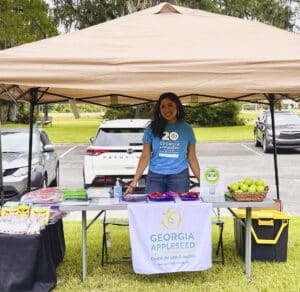
As a native Spanish speaker doing outreach, I often see families approach our table with hesitation, tense body language, and a hint of chagrin on their faces as they nudge their English-speaking children to the forefront, preparing for the next translation challenge. When I greet them warmly and begin speaking in Spanish, their expressions immediately brighten. Their shoulders relax, and the sense of relief is palpable.
This reaction is familiar to many first-generation children of immigrants. For me, the ability to connect culturally and linguistically with immigrant families reinforces Georgia Appleseed’s commitment to engaging directly with the families we serve—and reminds me why language access is so important to educational advocacy.
I saw this firsthand at the Migrant Equity event in Chatham County, where approximately 300 families came together to access free school supplies, immigration legal services, community resources, health screenings, and other support. Georgia Appleseed distributed donated school supplies along with our school discipline and special education advocacy resources, all translated into Spanish.
But our role went beyond distributing materials.
Throughout the event, I spoke with families about their children’s educational rights, particularly around school discipline and special education. I explained the school tribunal process, defined unfamiliar terms, walked families through our referral form for student legal services, and answered questions about evaluations, Individualized Education Programs (IEPs), and 504 plans.
Many parents shared frustrations about trying to get appropriate special education evaluations and support for their children while also navigating language barriers. Families and community partners described concerns about a lack of bilingual materials and linguistic support and the difficulty of distinguishing between a student who is still learning English and a student who may have a disability requiring additional services.
These distinctions matter. Systems designed to provide children with additional support can inadvertently create barriers for immigrant and migrant families when language differences are not adequately considered. A parent who does not have information in a language they understand may have a much harder time knowing what questions to ask, what services are available, or what rights they and their child have.
That is why I spent time making sure parents understood our Common Disabilities and Behaviors guide and Special Education Advocacy Toolkit. I wanted families to leave not only with materials in their hands, but with a clearer understanding of how to use them.
Parents have the right to ask questions. They can request evaluations and records. They can advocate for an IEP or 504 plan when their child needs support. And they do not have to navigate these systems alone.
The event also created a connection that will extend beyond the families I saw that day. I met Guadalupe “Rosie” Harrison, executive director of the Grow Initiative, who shared what she has been hearing about the special education challenges migrant families face in the area. Since then, she has become one of Georgia Appleseed’s referral partners, helping connect us with families who need our services in areas where legal resources can be difficult to access.
For me, that relationship illustrates why being present in communities matters. Outreach gives us an opportunity to share resources, but it also allows us to listen, build trust, understand the barriers families are experiencing, and develop relationships that help us reach families who might not otherwise find us.
Sometimes that connection begins with something as simple as greeting a parent in their own language.
The change in a parent’s expression when they realize they can speak for themselves rather than asking their child to translate is a small moment, but it says a great deal. Families should be able to understand their children’s educational rights, ask questions, and advocate for what their children need.
Our job is to help make sure they can.