
Keeping Kids in Class: The FAIR Project’s 2025–26 Impact

For a student facing a long-term suspension, the consequences can extend well beyond missed schoolwork. Time away from the classroom can mean falling behind academically, losing access to important supports, and becoming disconnected from school altogether.
Through Georgia Appleseed’s FAIR Project, we work with families to prevent unfair or excessive discipline so students can stay in school and continue learning.
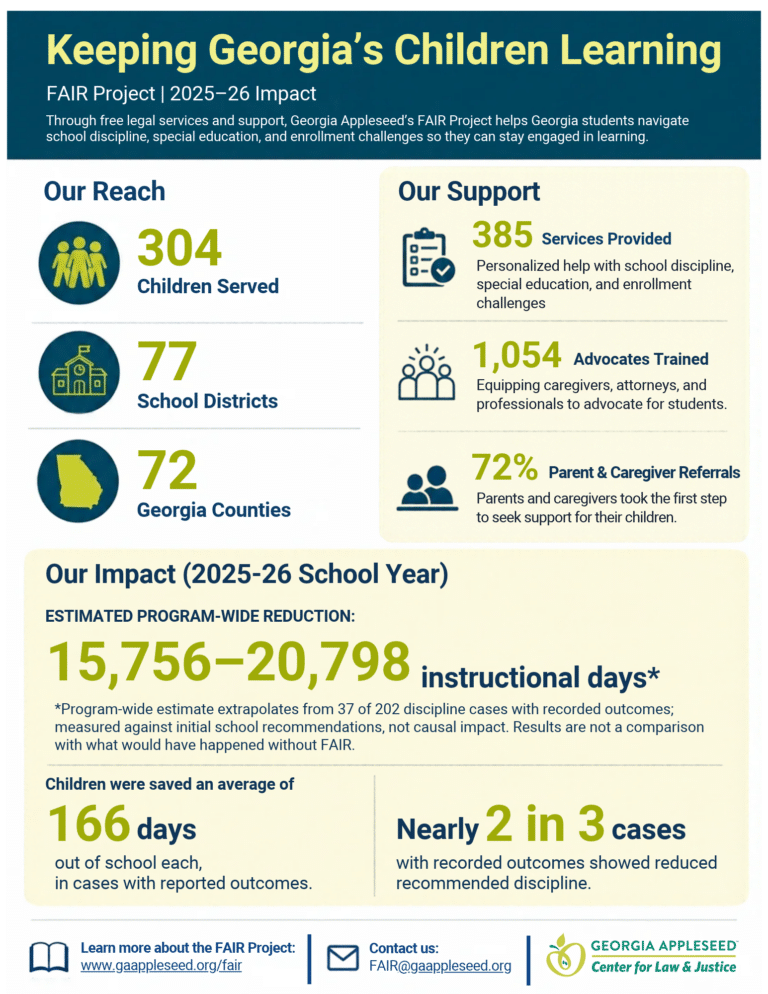
During the 2025–26 school year, our team helped 304 children across 72 Georgia counties and 77 school districts, providing individualized support with school discipline, special education, and enrollment challenges.
But one finding stands out to me: an estimated 15,756–20,798 instructional days that students could spend in the classroom instead of facing exclusion from school.
Behind that number are thousands of opportunities for children to keep learning, receive the support they need, and stay connected to their education.
Protecting Time in the Classroom
During the 2025–26 school year, FAIR’s work was associated with an estimated program-wide reduction of 15,756–20,798 instructional days of recommended school exclusion.
This estimate was developed using recorded outcomes from 37 of FAIR’s 202 school discipline cases. By comparing schools’ initial disciplinary recommendations with the outcomes recorded following FAIR’s involvement, the evaluation estimated reductions in recommended time out of school and extrapolated those findings across the broader program.
In cases with reported outcomes, children were saved an average of 166 days out of school each, compared with the disciplinary consequences initially recommended by their schools.
And in nearly 2 in 3 cases with recorded outcomes, students received less severe disciplinary consequences than schools had originally recommended.
These findings represent more than numbers. They reflect opportunities for children to remain in the classroom, continue receiving educational support, and stay connected to their schools.
While the program-wide estimate is not a measure of what would have happened without FAIR’s involvement, it illustrates the substantial difference between the disciplinary consequences initially recommended and the outcomes recorded in the cases evaluated.
Behind the Numbers: Students Given a Second Chance
The impact of FAIR’s work is best understood through the experiences of the students and families we serve.
In Whitfield County, an 11-year-old fifth grader faced serious disciplinary consequences after an incident involving a school resource officer. The student had become upset with his teacher, who had suspended him, and drew a picture of a gun. Law enforcement was called, and the child was suspended, arrested, and prohibited from returning to his alternative school placement.
With support from the FAIR Project, the family navigated the disciplinary process and secured a path for the student to return to school the following day, rather than remain excluded from the classroom.
In another case, a 16-year-old student in Henry County faced an eight-day suspension and possible removal to an alternative school following an incident involving a vape exchanged between students.
The proposed alternative school placement would have jeopardized the student’s college scholarship opportunities. After FAIR provided advocacy and resources, the student’s father successfully worked with the school to reconsider the disciplinary response. Instead of being sent to an alternative school, the student was given another chance to remain on track academically and athletically.
For both students, the outcome meant more than avoiding additional punishment. It meant preserving opportunities for their futures.
Empowering Families to Advocate
Our work doesn’t end with individual cases. During the 2025–26 school year, FAIR provided 385 services to help families navigate school discipline, special education, and enrollment challenges.
We also trained 1,054 advocates, equipping caregivers, attorneys, and community professionals with the knowledge and tools to better understand and protect students’ rights.
With 72% of FAIR referrals initiated by parents and caregivers, we know families are often their children’s strongest advocates. Our role is to make sure they have the information and tools they need.
Through community outreach, school discipline trainings, and partnerships across Georgia, we’re working to reach families before educational challenges become crises.
As one caregiver shared following an online training:
That knowledge can make a lasting difference. When families understand their rights and know where to turn, they are better positioned to protect their children’s access to education.
"When a child is considered a threat or just bad in the school system, it is hard to get the support you need, but now I know where to go."
That knowledge can make a lasting difference. When families understand their rights and know where to turn, they are better positioned to protect their children’s access to education.
Continuing the Work
School discipline remains central to our mission, but keeping children learning also means addressing barriers that can contribute to disciplinary challenges, including unmet special education needs.
On November 17, our FAIR team will host another free special education clinic to help families better understand their children’s educational rights and available supports. Click here to register for November 17 Special Education Clinic.
Every child deserves the opportunity to learn, grow, and succeed. As we reflect on this year’s outcomes, we’re reminded that every day in the classroom matters—and that supporting one student can change the course of their education.
If your child is facing a suspension, expulsion, or another educational barrier, we’re here to help.
Request FAIR Project Support: https://referastudent.org/
Learn More About FAIR: https://gaappleseed.org/fair-project/
Data note: The estimated program-wide reduction of 15,756–20,798 instructional days is extrapolated from 37 of 202 discipline cases with recorded outcomes. Reductions are measured against schools’ initial disciplinary recommendations, not against what would necessarily have happened without FAIR’s involvement. The estimate should not be interpreted as a causal measure of FAIR’s impact.